
COP30 Focus: Fossil Fuels and the Energy Transition
On Saturday 22nd November 2025 the gavel came down to mark the end of the 30th Conference of the Parties of the UNFCCC, COP30. We will conclude our miniseries on the main themes of the COP with a summary of what was decided, agreed upon, avoided and delayed in another blog, but in this article we will focus on what was decided regarding fossil fuels and the transition away from using them in our energy system.
First, a short remider of the science. Anthropogenic (man-made) climate change, including rapidly warming global average temperatures, is caused by greenhouse gases (mainly CO2 & Methane) emitted primarily during the burning of fossil fuels (coal, oil, gas). The entire fight to keep global temperatures within livable limits and away from potentially devastating tippping points, is dependent on reducing humaity’s emissions, which logically leads to the conclusion that we need to burn less fossil fuels.
Will oil have a sunset?
A History of Fossil Fuels in Negotiated Texts
The COP process was set up to require a consensus in order for any agreement to be signed off, not just a majority of countries. This means each agreement is by definition a compromise, and often the compromise has been between countries that want the world to rapidbly transition away from buring fossil fuels, and countries that see them as stategic geopolicially and economically, and would rather UNFCC texts simply focus on emissions. The first group has often included countries particularly at risk of climate change, like low-lying island states, while the latter group has often included the “like-minded group of developing countries”, a negotiating bloc of 24 countires including Saudi Arabia, China, and India.
Over time the tussle has gone back an forth:
In 2015 the ultimate compromise was reached with the signing of the Paris Agreement, that set the roadmap for the reduction of emissions. Yet fossil fuels are not mentioned once in the text, with the focus on emissions reductions and setting the blueprint for mechanisms like the Nationally Determined Contributions and Global Stocktake.
At COP26 in 2021 a concerted effort was made to include language in the final text focusing on the worst cuplrit for emissions, coal. With a push to include a pledge to “phase-out unabated coal”. At the last minute this language was objected to by India, and in order to mainatin the precious concencus, the COP President Alok Sharma gavelled through language to “phase-down unabated coal” instead. Despite the clawback, remarkably this was the first reference to fossil fuels being a cause of climate change in an offiial UNFCCC agreement.
This fight over the exact phrasing continued into COP28 in the UAE in 2023. The summit ended with an intention “to transition away from fossil fuels in energy systems, in a just, orderly and equitable manner”.
Many climate groups and more ambitious countries were hopeful that 2024’s COP29 in Baku would strengthen the phrasing around fossil fuels, but instead the reverse happened and no mention of the COP28 committment was made.
Which brings us to COP30. Noticably absent was the USA, which under President Trump has withdrawn from the Paris Agreement (although not the UNFCCC) so did not send a negotiating team. Once again the petrostates whose national incomes rely so heavily on fossil fuel revenues blocked any progress on strengthening the text and fossil fuels were not mentioned.
The post-COP30 analysis seems to indicate Saudi Arabia and Russia as the main culprits fighting to keep fossil fuels out of the text, but they might not be the only ones pleased with the outcome.
The US administration recently succeeded in scuppering a vote to set up a global emissions reduction program for shipping, by pressuring other members to vote for their amendment that delayed the outcome by a year. While COP30 doesn’t seem to have been mentioned during Crown Prince Mohammed bin Salman’s state visit to Washington DC in mid-November, its hard to imagine Trump being anything but pleased that specific language on fossil fuels was once again blocked from being in the legally binding final text in Belem.

Progress Despite the Obstacles
Despite fossil fuels not being mentioned in the final text, some progess was made towards setting out national plans to speed up the energy transition. As we wrote in a previous blog in this series, South Korea announced that it will join the Powering Past Coal Alliance, stop building new coal plants and phase out coal power generation, which provided 30% of its power consumption in 2024 from the 7th largest coal fleet in the world.
South Korea’s electricity by fuel source, you can edit the graph above to look at other countries and timelines. Courtesy of Our World in Data
Other Pathways to a Fossil Fuel Phase Out Agreement Emerge
In previous COPs, an alternative idea to the full 100% consensus of the UNFCCC negotiating process has emerged, that of a Fossil Fuel Non-Proliferation Treaty, inspired by Nuclear treaties that reduced the number of warheads after the Cold War, this is an idea rather than an organisation, but after first being endorsed by Vanuatu in 2022 has recieved the backing of 18 nations and the European Parliament.
Ahead of COP30, President Lula of Braxil called for roadmaps on fossil fuel transition and deforestation, and the idea became a key point of discussion in Belem. Although not officially announced, due to apparently being blocked by a group of 80 countries (some of which have since denied being against the idea, rather confusingly) the idea seems to have stuck.
During the COP, Colombia and The Netherlands announced that they will co-host a new conference in Spring 2026, on the Just Transition away from Fossil Fuels. As Irene Vélez Torres, Minister in Charge of Environment and Sustainable Development of Colombia, said:
“Colombia in alliance with the government of the Netherlands announces today the first international conference on the just transition away from fossil fuels. We invite all willing countries, subnational actors, campesinos, afros, indigenous, NGOs to join us in Santa Marta. This will be a broad intergovernmental, multisectoral platform complementary to the UNFCCC designed to identify legal, economic, and social pathways that are necessary to make the phasing out of fossil fuels.”
Along with this announcement, a separate Belem Declaration on the Transition Away from Fossil Fuels was produced, explicitly calling for and supporting a “just, orderly and equitable transition away from fossil fuels aligned with pathways consistent with limiting global temperature rise to 1.5degC”.
Countries supporting the declaration are: Australia, Austria, Belgium, Cambodia, Chile, Colombia, Costa Rica, Denmark, Fiji, Finland, Ireland, Jamaica, Kenya, Luxembourg, Marshall Islands, Mexico, Micronesia, Nepal, Netherlands, Panama, Spain, Slovenia, Vanuatu and Tuvalu.
It seems the split between countries keen to transition away from fossil fuels and those that remain hell-bent on excluding their mention from COP texts is hardening. This spells difficulty for future COPs reaching consensus, but on the actual question of whether the energy transition goes ahead, does that really matter?
Its the Economy, Stupid
In the end, the energy transition is driven by the economics. Of course Government regulation, international agreements and national plans matter, but while the back and forth has been happening in the COPs about whether to even mention the main culprits of climate change, the energy transition has been racing ahead.
The main driver has been the tipping of the economics of clean energy solutions into being more profitable that their fossil fuel alternative. A recent report by Ember on The Electrotech Revolution contained some fascinating stats:
More is spent on Capital Expenditure (CAPEX) for Solar PV than for Oil
General “electrotech” (solar, wind, batteries, heat pumps, EVs) investment is now twice fossil fuel investment, despite being lower than fossil fuels in just 2016
Solar PV costs are down 99.6% since 1980 ($/W)
Wind installation costs are down 80% since 1984 ($/kW)
Battery cell prices are down 99% since 1991 ($/kW)
Manufacturing capacity for solar and batteries is outpacing Net-Zero scenarios for demand through 2030
In only 15 years, Solar has gone from the smallest to the largest source of installed capacity
Electricity overtook oil as the largest supplier of useful energy in 2007, and is now at 34%, compared to oil’s 26%
Emerging markets are leapfrogging countries like the US in terms of installed solar capacity and electrification of their energy system - see our blog on the solar boom in Pakistan here.
These aren’t the only themes that are helping drive the push to clean energy despite a fracturing political consensus on climate change on both sides of the pond. In the UK, cost of living concerns mean more and more people are realising that natural gas prices are driving high electricity bills.
There has also been a resurgence in interest in nuclear power, both large scale fission plants (like Hinkley Point C, and the planned Sizewell C plant in the UK), as well as Small Modular Reactors (SMRs) which are seeing waves of positive announcements in the UK (see Rolls-Royce & Wylfa) and in the US where companies like TerraPower are progressing reapidly through regulatory approval.
The Dark Horse of the Transition is China
Despite being the largest economy in the world, it is not the US that is setting the pace or even direction of the energy transiton. Since its last attempt to grab that mantle during the Biden administration with the Inflation Reduction Act, the US at the federal level has reverted to treating climate and energy issues through a culture war partisan lens, withdrawing funding, gutting government departments, halting work on half-completed wind projects (later overturned), among many other executive orders, proclamations, and actions to the same affect.
Meanwhile, China has taken the helm.
The scale and speed of the energy transition in China is astonishing.
China emits a lot of CO2. 34% of global energy emissions, mainly from its huge coal fleet. But in 2024 80% of new additions to their electricty grid were in renewables. Clean technology now makes up 10% of their entire GDP, and a third of global clean technology investment is from China. Chinese companies now lodge 75% of global clean technology patents up from just 5% in 2000.
China also dominates the production and refining of the critical minerals used by clean technologies.
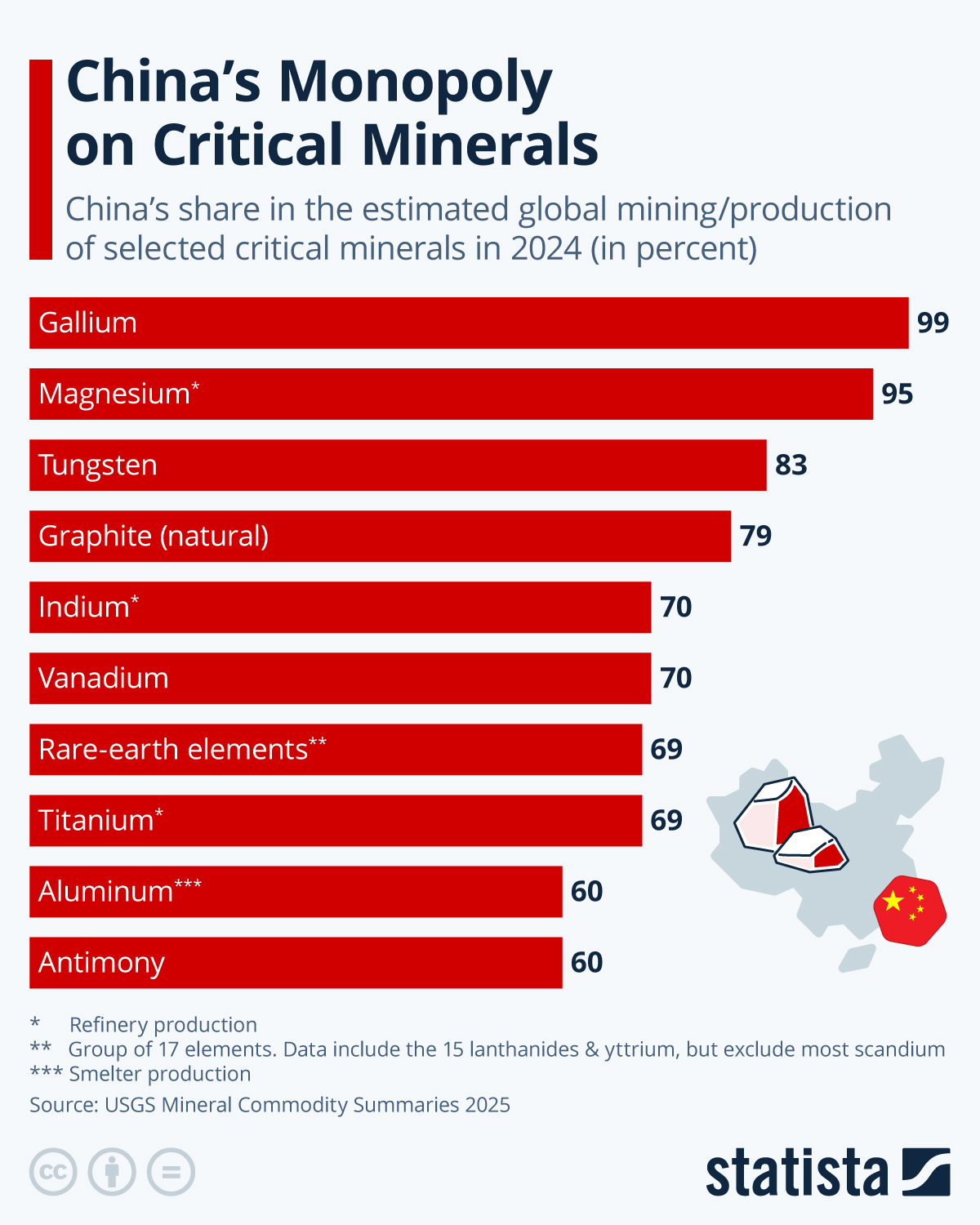 You will find more infographics at Statista
China’s Monopoly on Critical Minerals. Statista