
Major Report on Climate Adapataion Laws & Regulations in 35 Countries
In February 2026 the Grantham Research Institute on Climate Change and the Environment published a major report on 902 laws and regulations on climate adaptation across 35 countries.
The report, ‘Climate change adaptation laws and policies – A review of trends, gaps and opportunities in 35 countries’ (Tiffany Chan, Sara Mehryar, Martina Podestà and Anne Beswick) represents the best kind of foundational research, that will assist countries, governments and civil society to draw comparisons of best practice from around the world and to apply them to their own countries and circumstances.
The report notes that climate change impacts are intensifying, but that adaptation efforts are not keeping pace with the scale and urgency of emerging risks.
Policy making and law making on adaptation have increased significantly, especially since the Paris Agreement on Climate Change in 2015 and its Global Goal on Adaptation.
The study finds that between 2020 and 2024, more than 50% of Nationally Determined Contributions (NDCs) had a high emphasis on adaptation: all of these were submitted by countries in the Global South. This is consistent with our reports on National Adaptation Plans from the COP30 climate talks in Belém, Amazonia.
One third of sectoral laws and policies on adaptation focussed on environmental policy, including forestry and biodiversity protection.
Agriculture and food, and infrastructure and transport each made up about 10% of adaptation-relevant laws and policies.
Very few documents specifically integrated adaptation with water security, human health and cultural heritage, in the ways set out in the Global Goal for Adaptation.
Major improvements are still required in the areas of compliance, implementation and adaptation finance.
Linkage between climate adaptation and Disaster Risk Management is lacking in many countries.
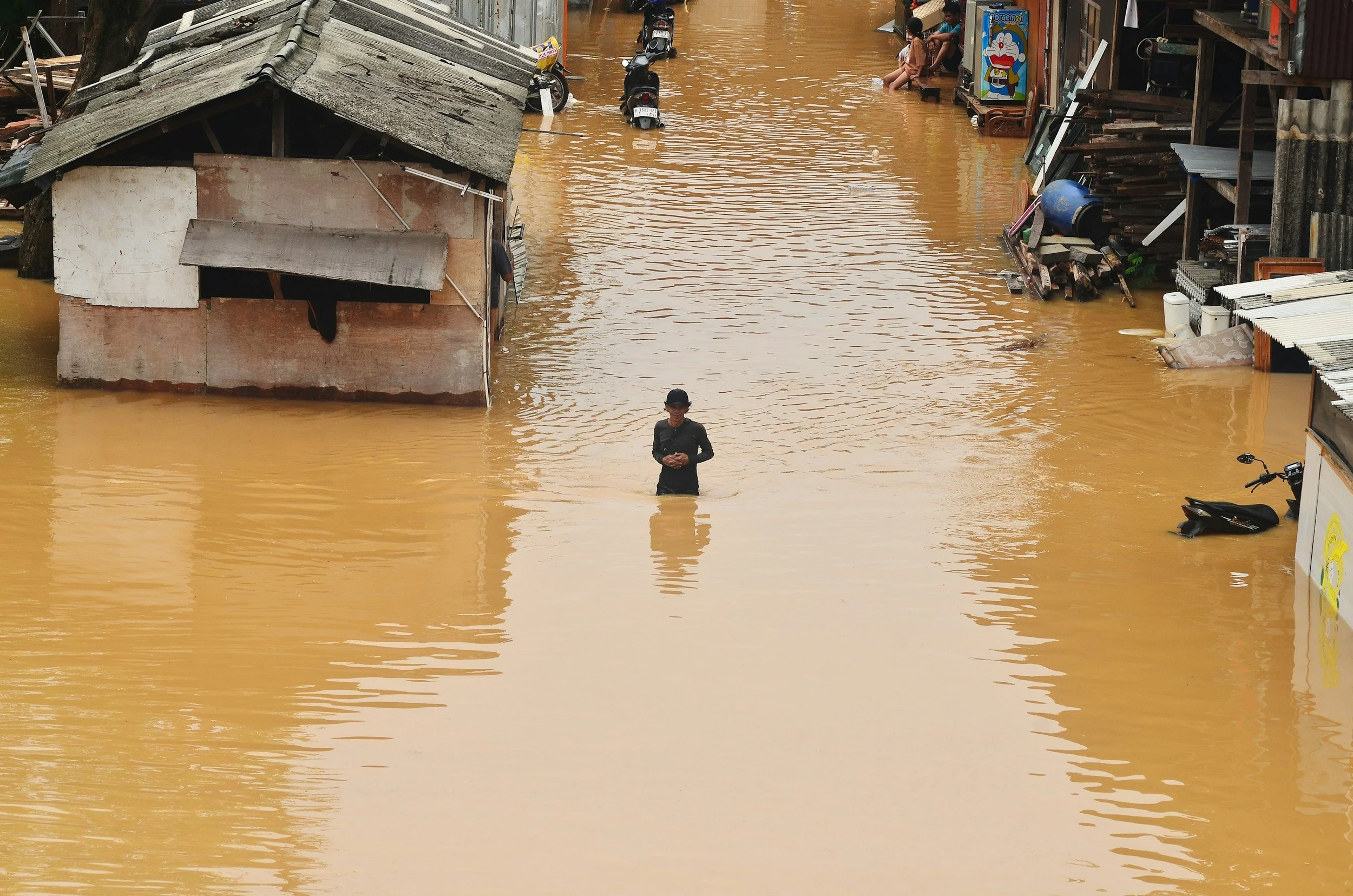
Flooding in Jakarta, Indonesia, March 3, 2025. Photo on Unsplash.
Based on their analysis, the authors of the report make three overarching recommendations for legislators and policymakers around the world:
Foster a whole-of-government approach to adaptation and systematically invest in institutional coordination mechanisms, both horizontally and vertically.
Institutionalise adaptation within public financial management and fiscal policy frameworks.
Increase policy coherence and integration of adaptation across disaster risk management and development policy domains.