
What’s the deal with Data Centers?
First thing first, what is a Data Center?
A data center is simply a a building, a dedicated space within a building, or a group of buildings used to house computer systems and associated components.
Sounds pretty simple. But in our IT-enabled world, there is nothing simple about either the engineering required to power them, or the resources they need to keep running. They need land, water (for cooling), and electrical power., and when you combine that need for resources with the surging demand for the services they provide for cloud computing and now AI, then you can start to see why they have become the hottest topic in energy circles.
In short, we’re going to need a hell of a lot of electricity to power all the data centers that the big tech companies want to build, and electrical grids (around the world) are not used to building this much power this quickly.
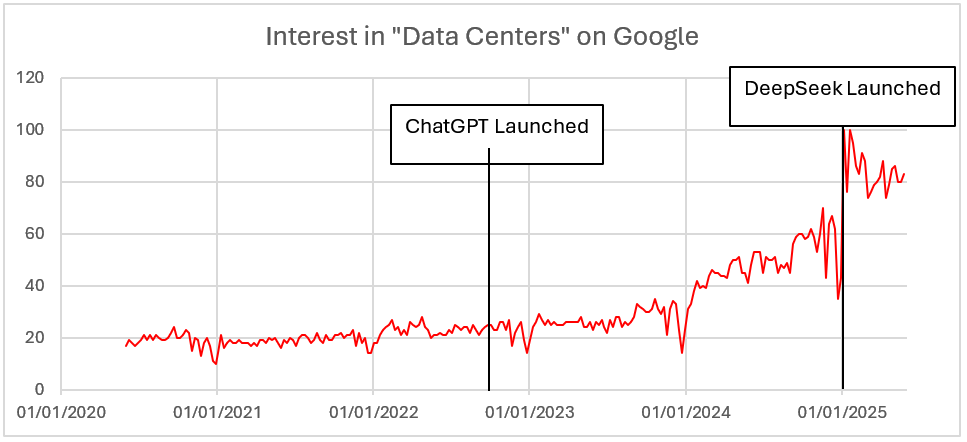
If you track google trends, you will find that since the early 2000s, interest in the term “data centers” had been fairly steady.
In the early days of computing entire rooms were requried to house computing equipment, before long, businesses began hosting servers in dedicated rooms in their office buildings, then large dedicated facilities started being built during the dot-com bubble of the late 1990s, and in the early 2000s the boom in cloud computing led to steady increases in spending on large data center facilities. Data centers have long been key to our IT-enabled world, but they have not made many headlines. They operate in the background, when you turn your laptop on the internet just works, when you save a photo to the cloud on your phone, it just happens.
So why has there been such a precipitous rise in the interest in data centers in the last few years? And what does any of this have to do with our electrical grid, energy system, and climate change?
The image below may provide a bit of a hint…
AI drives Data Center Boom
Since the 2010s there has been stready progress in the capability of Artificial Intelligence programs built from machine learning and large language models. This steady progress became a very public AI boom with the launch of OpenAI’s ChapGPT application in November 2022. Since then, there is hardly a tech company press release that doesn’t mention AI in some way, and the capabilities of the programs themselves has improved considerably.
This has led to numerous opinions, hot takes, books and podcasts on what role AI will have in our society in the future, what jobs it might replace, what tasks it can perform, how it affects everything from teaching students to intellectual property rights. As the AI boom has taken over the headlines, the interest in building large, power-hungry data centers has also skyrocketed.
This will not be a blog about AI - there are plenty already. In this article, I will look at the hardware that powers the large language models that underpin AI and examine the potential climate and energy impacts of their use.
What is in a data center?
A data center is essentially a warehouse, filled with servers, data storage systems, backup power systems, and networking equipment. And all that equipment needs a lot of cooling and power. A LOT.
If you want to see what is inside a massive new AI data center, then the video below is a pretty good starting point:
So how much power does a large data center use?
Well, taking the example of one data center being built in Ireland, it requires roughly the equivalent electricity supply of 50,000 homes. So its similar to the electricity demand of a town. To visualise that, the folks at RTE used lego in this brilliant demonstration. A big data center needs as much power as a small town.
How many data centers are we going to need?
The AI boom has led to a race to assess the potential increase in electricity demand that will result from all the data center construction that will follow.
To be clear, its not all future projections, a lot of data centers have already been built, 5,400 in the USA alone. In places like Loudon County in Virginia data centers are popping up like MacDonald’s restaurants. 70% of the worlds internet traffic passes through Loudon County, and the grid operators are predicting even more data centers will come online there.
What does this mean for the energy industry?
The simple reading of the AI boom and the subsequent boom in data centers, paired with their enormous energy demands, leads us to think that we are going to need an awful lot of power to supply them all.
Building a lot more electricity generating capability quickly is not something we are used to doing. In the US for example, electricity demand has been essentially flat for the last 30 years. So every power station we build is just replacing an older one coming offline.
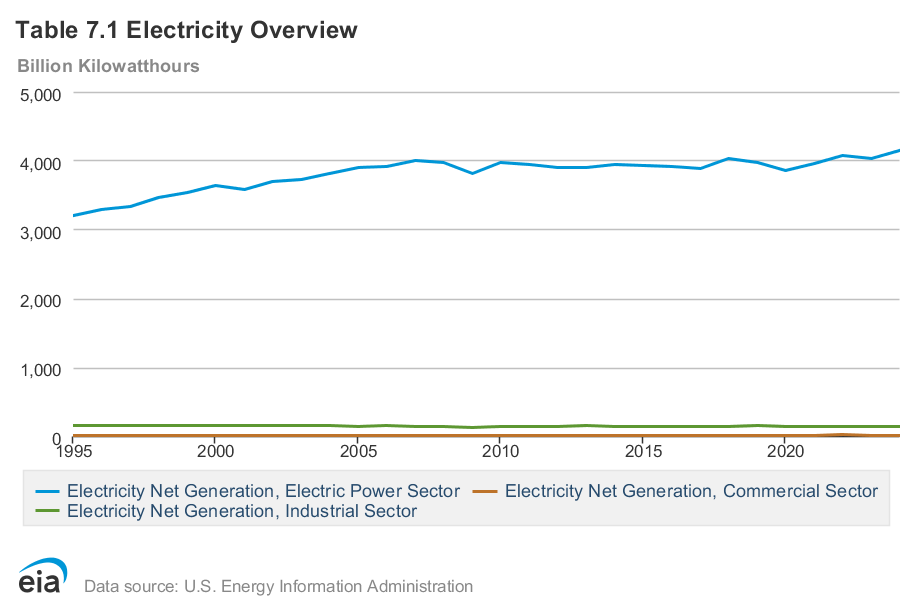
Grid engineers were already planning for an increase in electrical demand, due to EV charging, heat pumps, and the electrification of heavy industry. Data center energy use had always had a slice of the pie due to cloud computing, but the surge in interest and capital going to AI has brought it front of mind.
Local Impact
By their very nature, data centers are local power users, and the impact of running one is not spread out evenly across a whole grid in the same way as, for instance, EV charging would be. They are large local loads of power that need to be met by the grid at a single point.
In some states, like Virginia, they now represent over 20% of all power demand.
Another aspect worth considering is the pressure on local water systems by data center clusters. Earlier this year Bloomberg found that 2/3 of data centers built since 2022 have been in areas of high water stress.
Power Use Predictions
According to a 2024 DOE report, data centers used less than 2% of US electricity in 2018. By 2023 it was 4.4%. By 2028 they are forecast to consume 6-12% of US electricity.
There are numerous other predictions, from Goldman Sachs, FERC, Boston Consulting Group, and EPRI.
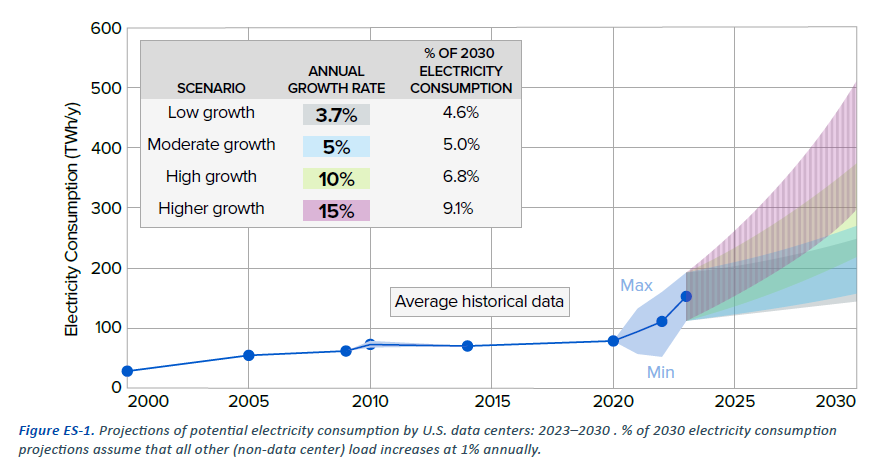
Whether or not these predictions come true is another question altogether, and a few key points could alter these predictions:
How much will we actually end up using AI?
Will AI get more efficient - like China’s Deepseek?
If it does, will it actually use less energy or will it follow Jevons paradox and actually use the same amount of energy to do even more work?
Can the tech industry keep up this insane level of capital investment?
Do data centers need power 24-7?
Normally, yes. But a recent study by Duke University entitled Rethinking Load Growth, makes the case that data centers could drastically reduce their impact on the grid if they are built to turn off, or turn down, their power demand by just a few hours a day. Essentially, they found that it only takes a bit of flexibility to drastically reduce how much new power generation you need to build to meet the demand.
The role of Nuclear
Like many other industries, including fuel cells, geothermal, solar and batteries, the nuclear industry has positioned itself as a potential answer to the question of what exactly will power all this demand.
The fact that we are now in a period of growing electricity demand has led developers to race to position their products as the solution, to help keep the lights on and the economy whirring.
In some cases, this has led to older plants being kept online or “uprated” to provide more energy. In other cases, nuclear companies are pushing to build Small Modular Reactors (SMRs). Terrapower are building a 345MW plant in Wyoming, and other designs are being worked on by companies like NuScale, Rolls-Royce, Kairos, GE Vernova, Westinghouse and X-energy.
What does this mean for the climate?
The climate impact will depend on how the data centers are powered. In theory, if they are all powered by clean energy like renewables or nuclear, then the emissions from their build out will be minimal.
But due to the speed they are being built, the time it takes to connect new load to the grid (many years in some cases), and the near constant nature of the electricity requirements, not to mention the Federal Government’s crackdown on renewables in general in the US, there are serious concerns they could just be powered by polluting coal or gas plants, thereby increasing emissions and making climate change worse.
In fact, this is already happening. XAIs data center in Tennessee has come under fire for being powered by a vast number of methane gas turbines. This also set up a potential clash between the climate goals of various large tech companies like Meta and Google, and their insatiable desire for power for data centers in the short term.
To summarise, data centers are big, they power the AI boom, they are being built rapidly across the US and the world, and they consume a lot of power (and water). Exactly how many will get built in the next decade or so remains to be seen, but their impact on the climate will depend on how we meet this new surge in demand. Going full steam ahead with a huge wordwide data center build out powered by fossil fuels will spike emissions. The responsible option is to be smart about it, make data centers behave with some flexibility to reduce their local grid impact, and use solar, batteries, geothermal and nuclear to power them.
Further Reading
Study finds headroom on the grid for data centers - Rethinking Load Growth
Data Centers contribute to rise in US power sector emissions - Ember
Podcasts
EP 133. Redefining Energy. 133. AI, Datacenters and Energy - May24