An interview with Gustavo Adolfo Castillo Cruz
What the Rise of Motocycles says about Povery and Public Failure
Some weeks ago we at The Borrowed Earth Project read an intriguing article with this heading written in the blog of the Oxford Climate Society. This was just after visiting Pakistan, where there is heavy motorcycle use, and it seems to be a major contributor to poor air quality.
So we were wondering who wrote this, and what gave him the ideas he was writing about? We contacted the Oxford Climate Society and the article’s author Gustavo Adolfo Castillo Cruz to ask if we could get permission to re-post this thought provoking article on our website. They kindly agreed, and we took the opportunity to interview Gustavo about his climate work with young people, and how he came to write it.
The Borrowed Earth Project:
We’d like to start by asking you, Gustavo, if you could tell us a bit about your background, the work you have been doing with young people on climate and environmental topics?
Gustavo Adolfo Castillo Cruz:
I am Gustavo Adolfo Castillo Cruz, a student and youth climate activist from Nicaragua. I have been deeply involved in initiatives that engage young people in climate action and environmental education, including Climate Cardinals and Acción Inspira International Foundation.
TBEB:
Tell us about Climate Cardinals and your work for them?
GACC:
Climate Cardinals is a global, youth-led organization focused on climate education and accessibility. Its core work revolves around translating climate information into dozens of languages so that people who are often excluded from English-dominated climate conversations can still access accurate and actionable knowledge. My work with Climate Cardinals has involved contributing to climate communication initiatives and collaborating with academic and institutional partners, including Yale University. What I value most about Climate Cardinals is how it empowers young people not just to learn about climate change, but to actively participate (whether through translation, advocacy, education, or local action) making climate engagement feel accessible rather than abstract.
TBEP:
And Acción Inspira? What does that do, and how does your work contribute to it?
GACC:
Acción Inspira is a youth-led international foundation that I am closely involved with (as the founder), focused on transforming climate concern into tangible action, particularly in communities in the Global South. Our work combines environmental education, community-based climate projects, and youth leadership development. Through Acción Inspira, I contribute by helping design initiatives that connect local realities (such as environmental degradation, access to resources, and inequality) with broader climate goals. The foundation places strong emphasis on empowering young people to see themselves not just as future leaders, but as current agents of change.
TBEP:
And why Motorcycles? How did you come to fix on them as indicators of public policy failure? It is easy to see how motorcycles might make a big difference, for example for students getting to and from university. But when you see a whole family balancing on a motorcycle, with small children asleep, and one of their parents weaving in and out of the traffic and traffic fumes, does it make you wonder if you would be using that kind of transport if you didn’t have to?
GACC:
Regarding motorcycles: my interest in this topic began in the small towns of central Nicaragua, where I noticed a rapid increase in motorcycle use, particularly among lower-income communities. Motorcycles often become the most practical solution for mobility in the absence of reliable public transportation, but their widespread use also reflects broader gaps in public policy and urban planning. Observing this trend first hand made me consider how transportation choices can both reveal and amplify systemic challenges, from social inequity to environmental impacts.
As I explain in my article, motorcycles are often the solution to a deeper structural social problem. In many countries, they are not a lifestyle choice but the only viable way for people to move. In Nicaragua, for example, it is very common to see entire families traveling on a single motorcycle, especially in rural and farming communities. This happens because public transport is either insufficient or nonexistent. If governments prioritized safe, affordable, and reliable public transportation, these situations would be far less common. Motorcycles, in that sense, are a response to systemic failure rather than its cause.
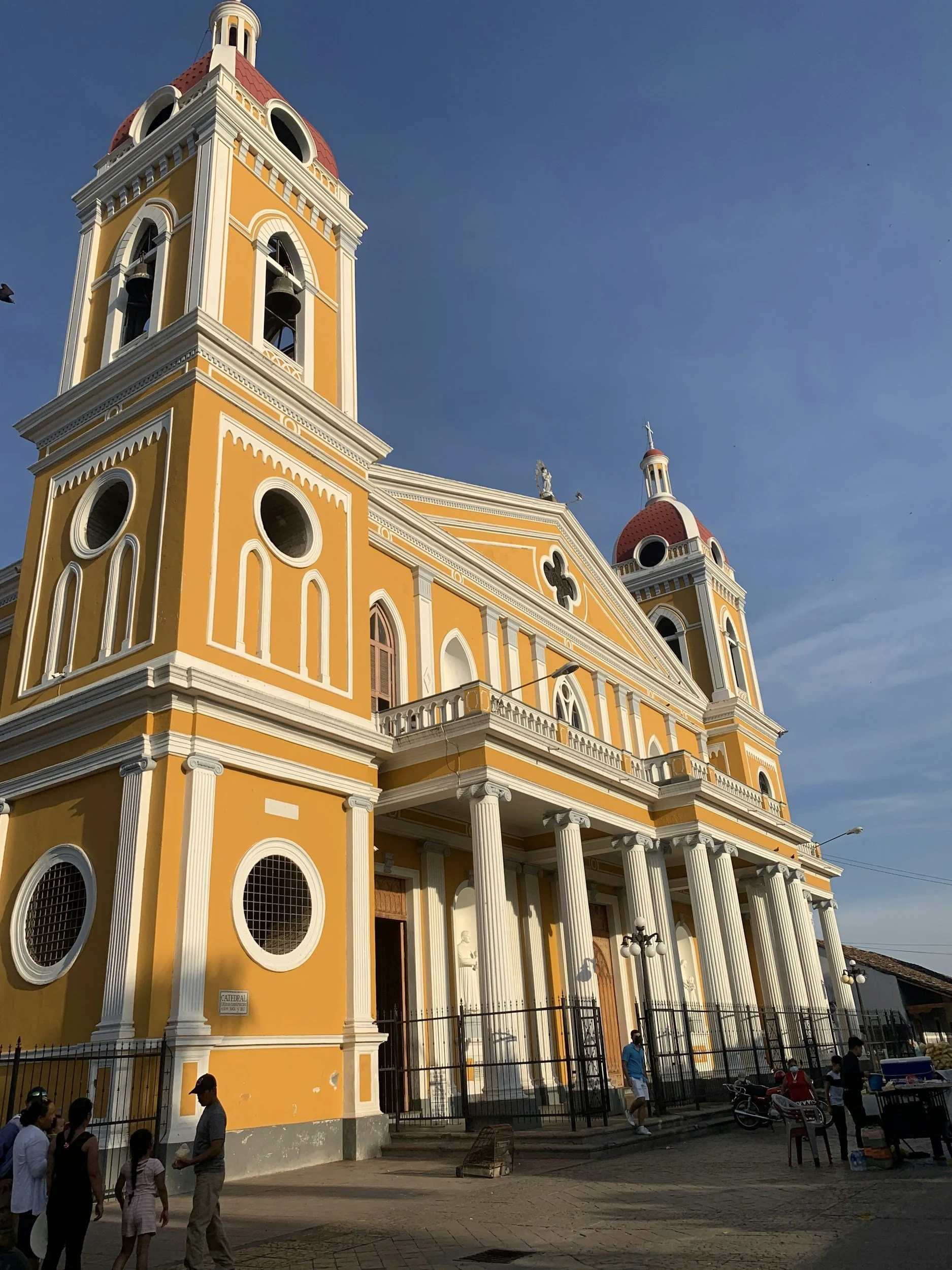
Granada, Nicaragua
TBEP:
What do you see as the links between motorcycle use and the lack of readily available public transport? Do you also see them as a major factor is especially poor air quality in cities and urban areas?
GACC:
There is a direct link between motorcycle use and the lack of accessible public transport. When public transit is insufficient or unreliable, motorcycles become the default choice, contributing not only to congestion but also to air pollution. This is especially critical in urban and semi-urban areas, where emissions from motorcycles accumulate quickly and affect public health and overall air quality.
TBEP:
Who should be responsible for the air quality from motorcycle exhausts? Is that all down to governments, or do manufacturers have some responsibility for the machines that they put on the market?
GACC:
Responsibility lies with both manufacturers and governments. Manufacturers play a major role by continuing to produce vehicles that rely on fossil fuels and by pricing them in a way that makes the most polluting options more affordable than eco-friendly alternatives. This pushes consumers toward choices that harm air quality, not because they want to pollute, but because those are the only options within reach. At the same time, governments share responsibility by prioritizing these systems instead of investing in renewable energy, clean technologies, and sustainable public transport. When cleaner options are neither accessible nor affordable, people are left with no real choice. Both industry and government are accountable for the air we breathe.
TBEP:
What would you see as markers of real progress in addressing the problems you have identified? What would that progress look like?
GACC:
In terms of progress, I see several key markers: investments in accessible and affordable public transport, stricter emissions regulations for motorcycles, urban planning that prioritizes sustainable mobility, and a cultural shift toward alternative, low-emission transportation. Real progress would be reflected in communities where people can move safely and efficiently without compromising air quality or social equity.
TBEP:
Environmental and climate change issues can sometimes seem like big, gloomy problems without much of a ‘way in’ for us as individuals. But at The Borrowed Earth Project we are constantly coming across people, like you, who are finding ways to combat that perception, and to get engaged and make a real difference.
What do you find really helps you to do that? Is it education and knowledge about climate change, or working with universities or fellow activists and other sources or expertise, or other things? What really helps get you fired up and keeps you going?
GACC:
I genuinely enjoy working on projects that have a real impact and help address the climate crisis in practical ways. Collaborating with other activists, NGOs, and academic spaces allows ideas to move beyond discussion and turn into action. What motivates me is being part of efforts where different perspectives come together to solve problems, especially when those projects are grounded in real communities and real needs. That sense of shared purpose and tangible progress is what keeps me engaged.
Thank you Gustavo, for your great work and example!