
A Fossilised Argument
Edward Wilson. 5 Min read. All views are the author’s own.
There has been a recent spate of opinions in the UK news recently against Net Zero.

With former Prime Minister Sir Tony Blair and former environment under secretary Rory Stewart joining the likes of Conservative leader Kemi Badenoch in putting forward the idea that the government’s drive to Net Zero is causing economic harm and should be re-examined.
As a reminder, Net Zero is the target of reaching a point where we sequester as much CO2 as we produce, effectively stopping our contribution to the production of greenhouse gases that are warming the planet. The World’s scientists say we should hit that by mid-century if we want to limit warming to 2°C, earlier if we want to stay under 1.5°C this century and avoid the worst climate impacts, with developed countries aiming to get there around 2050 or earlier, and developing countries by around 2060.
The UK committed to a 2050 date in 2019, when the Conservative PM Teresa May updated the 2008 Climate Change Act.
Net Zero is not an energy policy.
It does not say how we must power our grid or economy. You could in theory have a 100% coal powered grid with a whole bunch of carbon capture and be net zero (although I wouldn’t recommend it). It is an emissions target.
In 2024, when the Labour party came to power, Dept of Energy Security and Net Zero minister Ed Miliband set a target of 100% of the electricity grid being powered by clean energy by 2030 (up from 50% in 2024) and recently accepted the Climate Change Committee’s recommendation of an 87% cut in emissions from 1990 levels by 2040 (we are currently 54% below 1990 levels).
So what is all the fuss about? What are these politicians actually saying?
Former Prime Minister Sir Tony Blair wrote a scathing attack on the Labour government, and expanded on the energy portion during an interview with Times Radio:
Taxes are too high for working people, and some of the things we’re spending money on, I think we’ve got to change, so I’ve particularly identified the very large sum of money we’re spending on Net Zero which I just dont think is the right priority for the country now.
Interviewer:
You call on the Government to halt the Net Zero acceleration and prioritise cheap energy over clean energy, so for clarity, are you advising Keir Starmer to rip up Ed Milibands clean energy targets for example?
Tony Blair:
Yes I am, and I’ll tell you exactly why. Its not that I’m against renewable energy or clean energy, and its not that I’m a climate denier but its coming to terms with this reality: the 3 biggest emitters in the world today are China, America and India, together they account for just over 50% of global emissions. All of them are pursuing cheap energy and electrification, doesn’t mean to say they are not doing renewable energy it just means the lengths to which they judge policy is cheap energy and the need for electrification particularly in the age of AI. Britain’s emissions are around 1% of global emissions. So we can’t solve climate change and to impose costs on our own businesses and consumers in order to accelerate to Net Zero when the rest of the world is not doing so…I don’t understand the logic behind it. Or shutting down our own North Sea oil and gas industry in circumstances where again I don’t know of another country in the world that’s doing that.
Rory Stewart on The Rest is Politics Ep 537:
I think that in looking for the kind of things that are causing a big problem for the British economy and its competitveness and productivity, we’ve got to be honest about the fact that our industrial energy prices are very very high. The reason why the energy prices are high is because of the policies pursued by the Government and in particular the hurry with which Ed Miliband is pushing ahead for his particular 2030 targets. And why does it matter? It matters because if you’re a steel producer its really difficult to compete with European steel production, but most importantly for all, and you know I’m obsessed with AI and what we can do with our sovereignty and how we can stop ourselves being completely in hoc to China and the US when it comes to AI, we need to build data centers. If we don’t have, in the UK, the chips and the data centers (and they consume an enormous amount of energy) we’re going to be completely vulnerable to the US destroying our economy, taking away all our jobs, threatening our national security and we can’t get them (data centers) built and one of the major reasons we can’t get them built along with normal British problems with planning is the energy costs are just too high.
They may not like the comparison, but both Blair and Stewart are beginning to sound very like Conservative leader Kemi Badenoch. Who broke one of the most powerful and long-term oriented bipartisan consensus’ in British politics in 2025 by saying in a speech:
Net zero by 2050 is impossible. I don’t say that with pleasure. I want a better future and a better environment for our children. But we have to get real. Anyone who has done any serious analysis knows it cannot be achieved without a significant drop in our living standards or worse, by bankrupting us. Even if we hit absolute zero, we will not have net zero around the world, if other countries are not following us. And they are not. They certainly will not if they see us bankrupting ourselves to get there. Our success at reducing emissions has also come at a significant cost: the highest electricity bills in the developed world.
What’s extraordinary, is that so much of the cost of our energy bills is not directly from the wholesale cost of the energy. Huge amounts are being spent on switching round how we distribute electricity because we must effectively build two systems of electricity generation – one based on renewables and one not. One for when the sun shines and the wind blows. And one for when they don’t.
(Cabon Brief did a thorough debunking of this speech in an article here.)
After listening to the team at Outrage and Optimism talk eloquently about the moral issues with these arguments, I wanted to set out some of the practical points as well. Hence this blog.
What do they get right?
Energy prices are high compared to Europe (and the US)
True.
The UK has very high energy prices both for household consumers and large industrial consumers. Some of this is due to subsidies and taxes, but the bulk is made up of wholesale prices.
This is causing a competitive disadvantage for British businesses
True.
AI uses a lot of power and will be very important in the future
True and very likely true. See our blog on data centers here.
Its hard to build things in the UK
True.
Where are they wrong?
Energy prices are high “due to Ed Miliband’s 2030 target”
False.
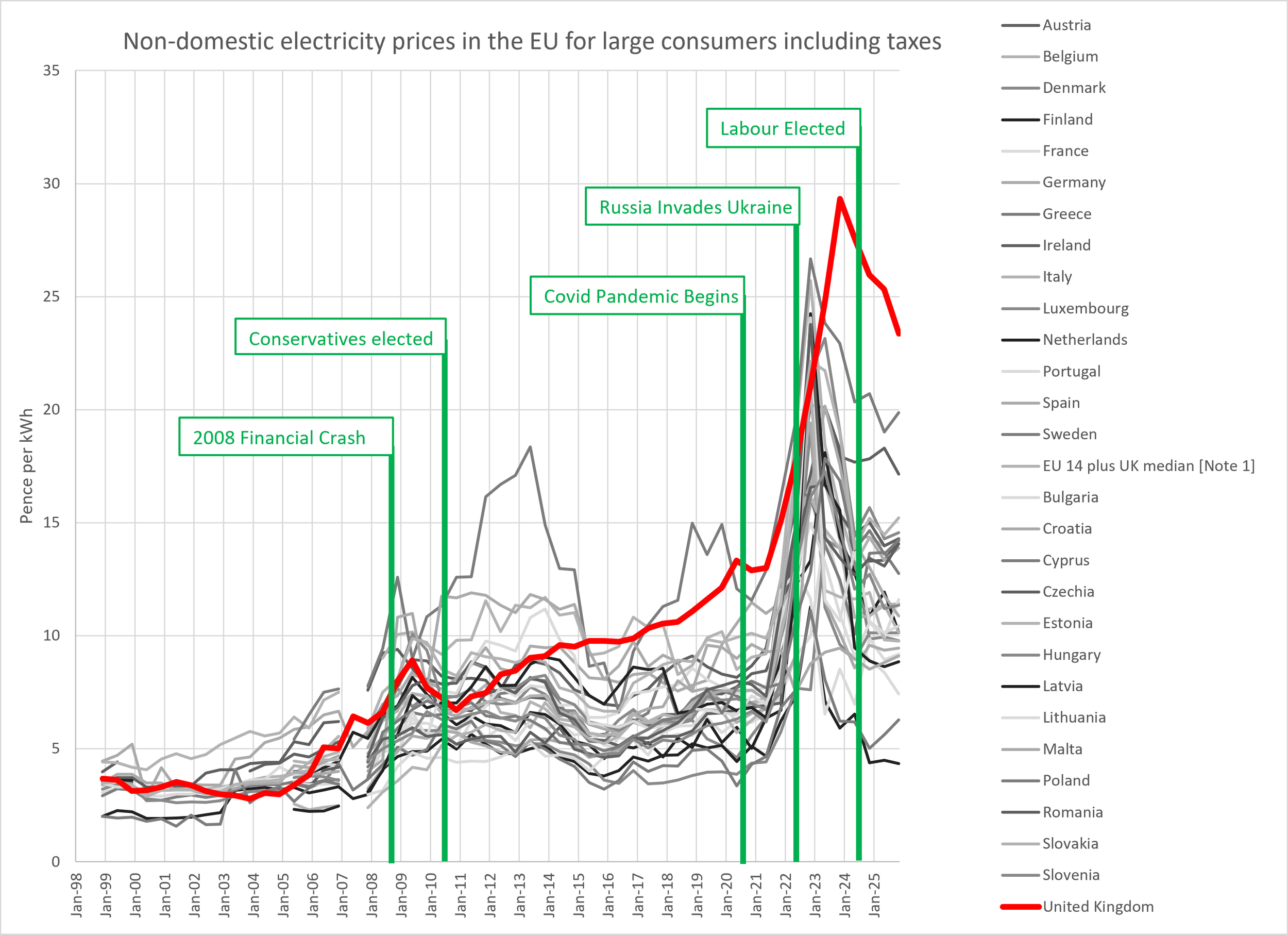
Graph: The Borrowed Earth Project. Data: https://www.gov.uk/government/statistical-data-sets/international-non-domestic-energy-prices
The target (to get 100% of our electricity demand sourced by clean power) became UK policy once Labour were elected in mid-2024. UK’s energy prices were the highest in Europe before Labour took power. In fact they have been amongst the highest in Europe since roughly the time the Conservatives took over in 2010, with a big spike compared to other European countries around the middle of the pandemic and Russia’s invasion of Ukraine.
Did the (then conservative) govenment approach to energy taxes and Net Zero change radically during that time to cause this spike? No.
“Policy costs” such as green levies account for roughly 16% of UK electricity bills. This is not an unsubstantial amount, but its also not new, and hasn’t changed very much since Labour came into office, the climate change levy was introduced in 2001 and increased slightly in 2026 after being flat for 3 years. Whereas the wholesale portion of the cost has spiked.
The push to clean energy is what is causing our wholesale electricity prices to be high
False.
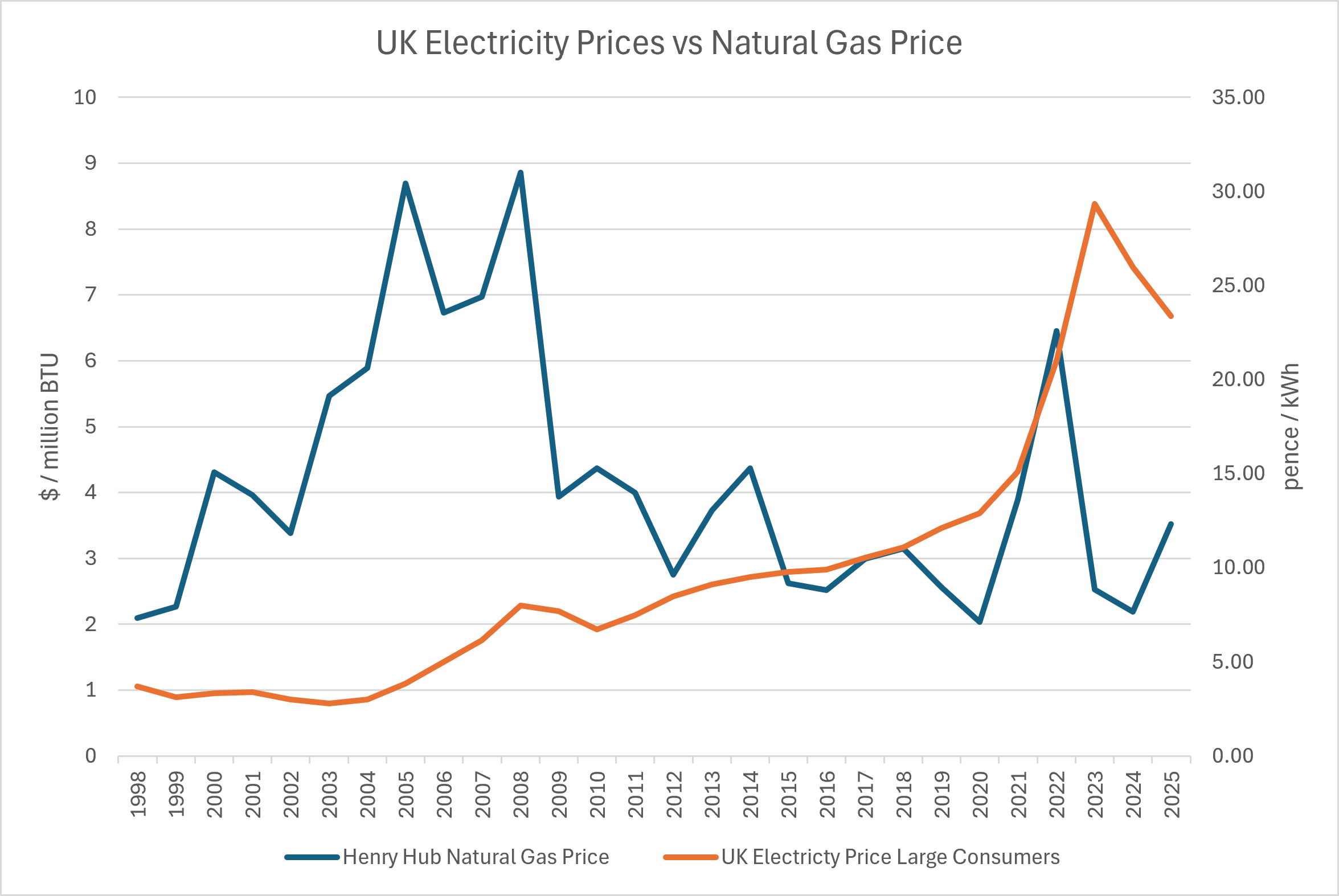
Graph: The Borrowed Earth Project. Data: https://www.gov.uk/government/statistical-data-sets/international-non-domestic-energy-prices & https://www.eia.gov/dnav/ng/hist/rngwhhdA.htm
If you want to find a single culprit for the high wholesale price of electricity in the UK, it is our overreliance on Natural Gas burning power plants in our grid. Carbon Brief has done a deep dive into this question, which is well worth a read, but I’ll try and sum it up here.
Electricity wholesale pricing works by the grid turning on the cheapest power first, then progressively turning on more expensive power until demand is met by supply.
The overall price of the electricity sold to consumers is set by the last bit of power generation that you turn on, which is called the marginal price. Very often in the UK grid we have nuclear running all the time (cheap to keep turned on), then add wind and solar and interconnectors, and then for the last bit (the bit that sets the price) we run a flexible natural gas plant that can fluctuate with the fluctuating demand. This makes electricity prices very sensitive to natural gas prices.
Electricity prices spiked in 2022/2023, what else spiked in 2022/2023? The price of Natural Gas.
Prices are also affected by distribution costs, and taxes including the climate change levy, but the bulk comes from the wholesale price.
The UK government is taking some steps to “break the link” More details here.
Kemi Badenoch received a live fact-check on the link (or lack thereof) between Net Zero and industrial energy prices on ITV recently:
Clean Energy is not Cheap Energy
False.
There seems to be an assumption that we need to slow the transition to reneawables (and therefore burn more fossil fuels) in order to make our electricy prices lower.
They seem to believe that clean energy is not cheap energy. This may have been true in 2007 when Blair left office, possibly even 2019 when Stewart did, but is is not true now.
Rapid expansion in the use of renewable energy sources – such as wind and solar PV – is transforming electricity markets worldwide. Government subsidies have been crucial to support wind and solar PV deployment in the past, but with costs for these technologies now falling below those of fossil fuels power plants almost everywhere, the policy debate has shifted.
Across many wholesale electricity markets, especially in Europe, a higher share of renewables in the power mix has consistently led to lower prices. This outcome stems largely from the lower marginal costs of renewable energy sources such as wind and solar compared with fossil fuels. When renewables supply a greater portion of electricity, they displace more expensive forms of generation, pushing overall prices down. The correlation between the share of renewables in electricity generation and hourly electricity prices is generally negative in Germany, Spain, the United Kingdom and France, where natural gas power plants usually set the hourly price.
In other words in the UK, renewables are currently saving us from even higher prices because we are using less natural gas - so how exactly would using more help us reduce electricity prices? This is an argument for going faster in greening our grid, not slower.
Drilling the North Sea will help us
Not really.
Drilling the North Sea, a diminishing resource, would have little to no impact on the wholesale price of natural gas so long as the companies that drill it go on to sell it on the global market. We could nationalise an oil and gas company and provide subsidised gas to the UK consumers, but as that is unlikely at this point, to pretend that we have a US shale-revolution type resource on our backyard that would make everything affordable if only we unleashed it, doesn’t stand up to scrutiny.
Electrification and Net Zero are opposing Forces
False.
The TBI report states:
We must prioritise cheaper energy and electrification over net zero and use what is left of our North Sea oil and gas resources. This is essential for our competitiveness and for taking advantage of AI.
This doesn’t make any sense. Net Zero is an emissions target, it doesn’t define a pathway, and electrification actually happens to be probably the best pathway to getting there. That is what China is doing, and they are on track to become the world’s first electrostate, perhaps we should try and keep up?
And finally, Net Zero is stunting economic growth
Again, false.
This is the most pernicious argument underlying the critques of the anti-Net Zero sentiment, and it is just not true.
UK economic growth decoupled from CO2 emissions completely in about 2016.
The Labour government made “going for growth” the main pillar of their agenda, for better or worse, and CBI economics recently found that the clean energy industry is now worth more than £100bn a year, a million jobs and benefits the whole country. As we have already seen, increasing the share of renewable energy in our grid is actually reducing electricity prices, which have fallen sharply since a peak in 2023 - long may that continue.
As is often the case in these debates, no one seems to be asking “what would the impact to the economy be of us not tackling climate change?” The answer - huge. As the Climate Change Committe’s latest Carbon Budget says:
For every pound spent on Net Zero, the benefits outweigh this by 2.2 to 4.1 times.
Avoiding climate damages is the most significant benefit of the transition. This saving is estimated between £40 billion and £130 billion in 2050.
Decarbonising the last few % of the grid may become costly and suffer from diminishing returns, due to the system changes needed to account for long periods of low wind and sun in winter. That is a challenge, but it does not negate the general trend that pursuing a greener industrial policy is one of the main ways the UK can actually grow its economy.
There seems to be a narritive push in the UK, not just from Reform UK, fossil fuel interests, and the usual climate change denier types, but increasingly from self-styled “concerned allies” of the climate movement, to say that Net Zero is just too big a hassle, too expensive, and we should scrap it to focus on other big important things. These arguments are often based on entirely false premises, as I hope we have begun to show in this article, and assuming they have been made in good faith, then it is inumbent upon the rest of us who have put some time into understanding how the energy system actually works - to point that out before they become conventional wisdom.