
New Nuclear Builds Get A Boost
All views an opinions are those of the author, not his employer.
In the past several weeks, nuclear Small Modular Reactor projects have made strides towards completion in the UK, US, and Canada.
These plants would be the first SMRs of commercial scale built in their respective countries, and mark a step forward in what the industry hopes is a full nuclear power revival.
What is the promise of Small Modular Reactors?
Nuclear power provides 9% of the world’s electricity, down from a peak of 17% in the 1990s. With electricity demand rising again in the US and globally, and the need to produce clean power still paramount with climate change continuing at pace, interest in building more nuclear plants has rekindled in many countries.
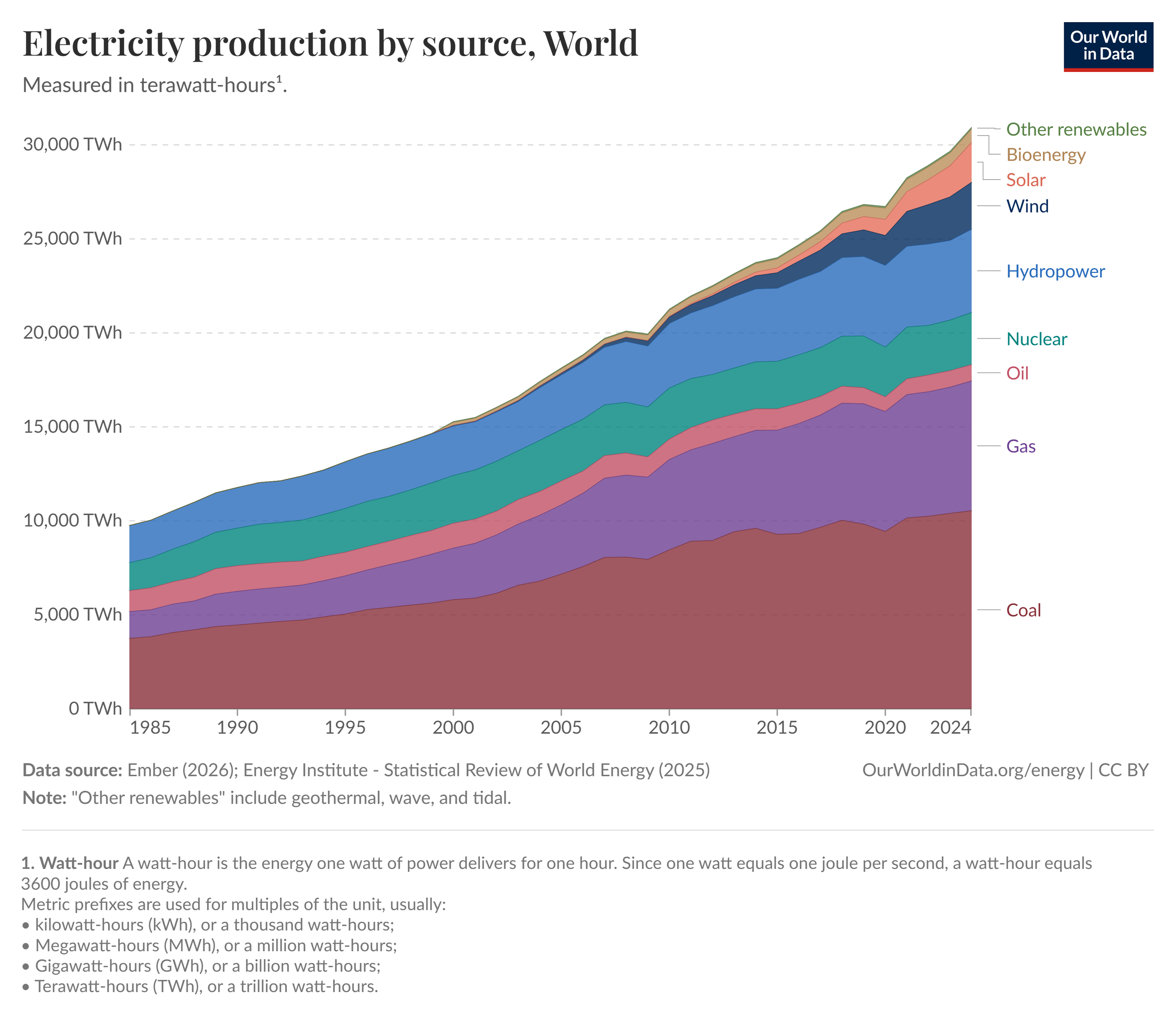
Data: Ember (2026). Energy Institute - Statistical Review of World Energy (2025) – with major processing by Our World in Data
But building large nuclear power plants can be slow and costly. Bent Flyvbjerg talks about them in his excellent book “How Big things Get Done”, where he calculates they have an average cost overrun of 120% in real terms, and schedules running 65% longer than planned. The only worse performing projects in his database are nuclear storage facilities, and the Olympic games.
The problem is, the electricity grid needs a lot of power, which means nuclear has to deliver at scale.
One way to design and deliver a project on an enormous scale is to build one big thing. Most nuclear power plants are. If you build like this, you build only one thing. By definition that thing is one of a kind. Nuclear power plants are the products of a staggering number of bespoke parts and systems that must all work.
He goes on to explain that large nuclear plants also suffer from other risks that make building them so hard, you cant recuperate any money until they are built, you can’t get experience building mulitple identical plants if you build a one of a kind, its hard to build one - see what works and make tweaks - before you start on the next, and you can’t experiment during the build because it is so critical to get things right first time. Big plant builds are also suceptible to “black swan” events, low probability, high risk occurances that can scupper the whole project. The longer a project takes the greater the chance of one of these events happening.
So the promise of SMRs is to avoid these risks and build nuclear plants in a different way.
The “modular” in small modular reactors means building a plant from a series of mass-produced components made in factories in such a way that each individual component gets cheaper the more you make, and building the plant gets cheaper the more you learn by doing it. Plants are smaller, so can be built quicker, and by building multiple the learning rates should lead to lower costs and faster builds.
There are various defintions for SMRs, ranging from microreactors the size of a shipping container, to modified versions of the nuclear reactors currently used in hundreds of naval vessels, to power plants similar in ouput to an average coal plant. There are also several competing reactor technologies, but the general idea is the plants would be made from factory mass-producable components, taking advatage of the falling costs of mass-production.
There are over 25 companies worldwide developing designs for SMRs, a couple of plants are already operable in Russia and China, several more are under construction, and most are in various stages of regulatory approval.
In recent weeks, two designs made big strides towards their eventual builds.
USA - TerraPower
In the USA, TerraPower has been granted a construction permit from the NRC to begin nuclear construction activities in Kemmerer Wyoming on their Natrium plant.
TerraPower’s Natrium reactor is a “345 MW sodium-cooled fast reactor with a patented molten salt-based energy storage system. The storage technology can boost the system’s output to 500 MW of power when needed as it is designed to keep base output steady, ensuring constant reliability, and can quickly ramp up when demand peaks — it is the only advanced reactor design with this unique feature.”
Sodium-cooled reactors are a particular type of advanced reactor that use liquid sodium as the primary coolant, as opposed to the boiling water or pressurized water used in many existing designs. This allows the reactor to run at much lower pressures, reducing the thickness of the reactor vessel. The plant is also air cooled, meaning it doesn’t need to be sited next to a large water source.
Kemmerer Unit 1 is being built near the site of a retiring coal plant in Wyoming, is due to come online in 2030, and would be the first utility-scale advanced reactor built in the US. The molten-salt storage system will allow the plant to ramp up and ramp down its output depending on the needs of the utility and the grid, which can be a very useful addition feature to have in a power source as the needs of the grid fluctuate.
TerraPower also recently announced a deal with Meta for a further 8 Natrium plants, producing a total of 2.8GW that can be boosted to 4GW with the storage system.
Canada - GE Vernova Hitachi
To get an overview of the various SMRs being built around the world and how they are progressing, check out this great tool from the World Nuclear Association: Small Modular Reactor (SMR) Global Project Tracker
The first SMR built in the G7 may end up being in Canada. This month Ontario Power Generation submitted its application for a licence to operate the BWRX-300 plant under construction at the Darlington New Nuclear site.
OPG recently passed a “hold point” which will allow them to begin work on the reactor building foundation, having already recived a construction license from the Canadian Nuclear Safety Commission (CNSC).
GE Vernova Hitachi Nuclear Energy's BWRX-300 is a 300 MW water-cooled, natural circulation SMR with passive safety systems, based on a boiling water reactor design that previously went through US regulatory certification.
UK - Rolls Royce
Meanwhile, in the UK, Rolls-Royce have signed a deal with the government owned Great British Energy - Nuclear company, that will allow them to start delivery work on three SMRs in Wylfa, North Wales.
Wylfa was the site for a Magnox reactor from the 1960s, that was decomissioned in 2015. It was the proposed site for two new large reactors for many years, with plans by Horizon and Hitachi eventually falling through in 2019.
However, in 2025 Rolls-Royce was chosen as the preferred technology bidder for the development of 3 SMRs at Wylfa. The Rolls-Royce SMR reactor is a 470MW design, based on a smaller version of the pressurized water reactors, with several design features that are intended to reduce construction time and allow the majority of components to be fabricated off-site and shipped in.
The new agreement allows work to start on site, "through a firm contract allowing Rolls-Royce SMR to develop its site-specific design and order critical components from the supply chain". In a separate deal the National Wealth Fund has committing up to GBP599 million (USD805 million) to Rolls-Royce SMR to support the development of its reactors.
The its counterparts in the US and Canada, Rolls-Royce SMR are proceeding through the various stages of regulatory approval via the UK’s Office of Nuclear Regulation (ONR). They are currently in the 3rd and final step of the Generic Design Assessment (GDA) process that every new plant has to go through, and will need to complete that step prior to operation, as well as decide their final financing model. The other SMR designs to have completed Step 2 are Holtec and GE.